Context
A company’s commercial interaction — in the customer/supplier relationship — is like a constantly beating heart. It cannot stop. For a customer, the supplier is unique, even if other offers exist in the market. For the supplier or the sales system, the customer must stop being just a number. Precise, fast, and above all highly personalized responses need to be dynamic. And the shorter the response time, the greater the chance of successfully closing deals. This is the dream of every organization, whether supplier or buyer.
To achieve such performance, every company needs control information, internal and external transactions, goals, culture, and, above all, skilled people. Software — including ERP systems — is available as a vital resource for planning the enterprise management integration system. It serves the transactional layer among different departments from a systemic and functional perspective. An ERP, like all other systems, has its boundaries. In an attempt to expand these boundaries, companies often replace the ERP, only for new boundaries to emerge, which is not the most appropriate solution.
The Problem
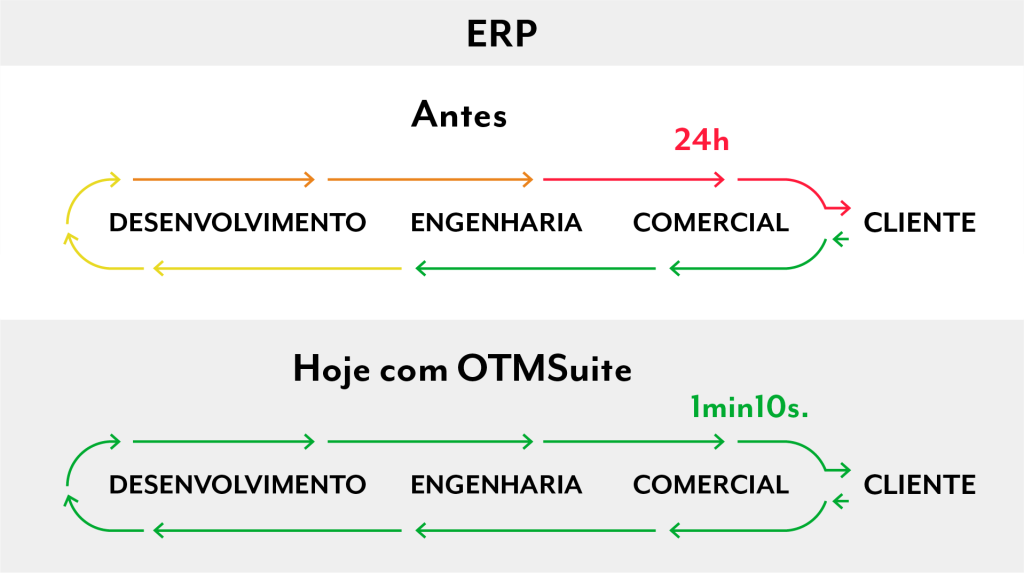
In Tabone’s case, for processing manufacturing information originating from the commercial area, a set of technical data required cross-departmental information. These operations are generated from customer needs, always starting from highly customized products. To handle this demand, the IT department faced the challenge of presenting effective solutions to maximize the time and energy invested by teams — from the commercial area, through engineering and development, returning to engineering and development, product and process, information registration, cost/price analysis and formation, and only then returning to the customer. As simple as it may seem, the operations required fluidity, data accuracy, and communication among the various departments. A task that the ERP, in terms of integration, required and demanded manual registration in each of the operations (item creation including all technical, commercial, and legal information, product structures, and manufacturing routings) and for each new order originating from the commercial sector.
The Solution
The solution presented, together with Tabone’s IT team, was the automation of the process through the implementation of OTMSuite, generating this data set dynamically by leveraging the information layers already fed into the ERP. Customization, speed, delivery deadlines, and commercial responsiveness are competitive differentiators, but they require “arms” capable of supporting this strategic, tactical, and operational orientation. The solution proposed to the client was the creation of an “engine” to automate both item registration and the creation of product structures and manufacturing routings, aiming to sustain the ability to deliver to the end customer — in a significantly shorter time — all the information necessary for product registration and quotation.
The Result
The implementation of OTMSuite enabled time maximization and reduced the involvement of people across multiple information sources, consequently ensuring accurate data. “What used to take us 24 hours to process, today in just over one minute we are able to return the processed order,” reports Rodrigo Luís Machado de Oliveira — IT Supervisor at Tabone Indústria e Comércio de Plásticos Ltda.